BlogLearn Stock MarketWhat is the Stock Market? A Beginner’s Complete Guide

What is the Stock Market? A Beginner’s Complete Guide

What is a stock market?

A stock market brings together buyers and sellers of company shares. When you buy a share, you own a small part of that company and become entitled to a portion of its profits and assets. Share prices change every moment based on supply and demand, company news, earnings, and broader economic events. For beginners, remember: price moves reflect what investors collectively expect about a company’s future.


Why do companies issue shares?

  • Raise capital: Companies sell shares to get money for growth—new products, factories, acquisitions, or to pay off debt.

  • Spread risk: Selling ownership spreads business risk to many investors instead of a few owners or lenders.

  • Liquidity and public profile: Listing on an exchange makes it easier for founders and early investors to sell, and raises the company’s visibility and credibility.

Why do people invest?

  • Potential returns: Investors buy shares hoping their value will rise and/or to receive dividends (a share of profits).

  • Beat inflation: Long-term investing in equities often yields returns higher than inflation.

  • Ownership and voting: Shareholders may get voting rights at company meetings, influencing major decisions.

  • Income: Some investors seek regular dividend income from stable companies.

Difference between Stock Market and Share Market

In everyday language, “stock market” and “share market” mean the same thing: venues where equity securities trade. The term “stock market” sometimes has a broader sense that includes indices, ETFs, and derivatives, while “share market” may emphasize individual company shares. For practical purposes as a beginner, treat them interchangeably.


How the Indian Stock Market works

Companies that satisfy regulatory and exchange criteria list their shares on stock exchanges. In India, most trading happens electronically through brokers who route orders to exchanges like the NSE and BSE. When buyers and sellers agree on a price, the order is matched and executed. After a trade, the ownership and cash move through a settlement process handled by central depositories (NSDL and CDSL); settlement timelines follow current rules (e.g., T+1/T+2). Prices are discovered continuously as market participants react to earnings, economic data, and news.


Primary Market vs Secondary Market

The primary market is where a company first issues shares to raise capital — for example, in an IPO. Investors buying in the primary market pay the issue price, and proceeds go to the company. The secondary market is where those shares are traded among investors after listing; trades in the secondary market do not raise new funds for the company but provide liquidity and price discovery for investors.


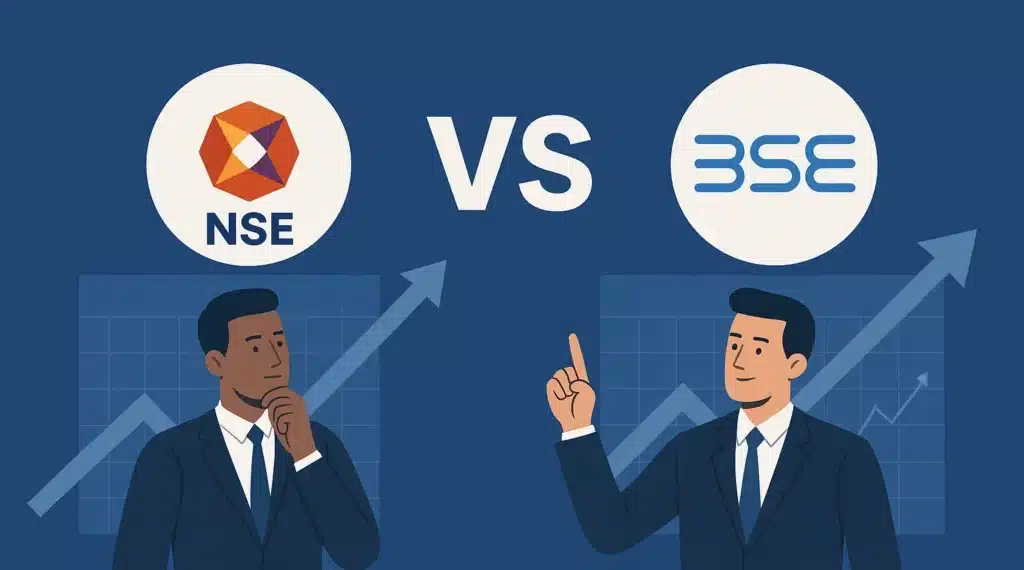
Major stock exchanges in India (NSE & BSE)

  • National Stock Exchange (NSE): Known for high electronic trading volume and the Nifty 50 index, which tracks 50 large-cap companies.

  • Bombay Stock Exchange (BSE): One of Asia’s oldest exchanges, with the Sensex (30 companies) as its benchmark index.
    Both exchanges list thousands of securities and host derivative contracts, ETFs, and mutual fund trades.

SEBI’s role

The Securities and Exchange Board of India (SEBI) is the regulator that protects investors and ensures fair, transparent markets. SEBI sets rules for disclosure, approves IPOs, registers and supervises brokers, and enforces actions against malpractice. Its oversight builds trust, which is essential for public participation in markets.


Benefits of investing

Investing in equities offers potential for higher long-term returns compared with many other asset classes. Key benefits include:

  • Wealth creation over time through price appreciation and dividends.

  • Compounding when returns are reinvested.

  • Liquidity, since listed shares can be bought or sold during market hours.

  • Diversification when combined with other assets.
    For many beginners, index funds or mutual funds are an easy way to access these benefits without choosing individual stocks.

Risks involved

Stocks can be volatile, and prices fall sometimes sharply. Major risks include:

  • Market risk from economic downturns or geopolitical shocks.

  • Company-specific risk if management or earnings disappoint.

  • Liquidity risk, especially in small-cap stocks.

  • Behavioral risk from emotional decision-making (fear and greed).
    Understanding these risks and aligning investments with your time horizon and risk tolerance helps manage them.

Common myths

There are several myths that discourage or mislead new investors. A few to note:

  • “Stock market is gambling.” It can resemble gambling if you speculate without research, but disciplined investing with diversification and a plan is not gambling.

  • “You need a lot of money to start.” Modern brokers and mutual funds allow small starts, including SIPs (systematic investment plans) and fractional investing.

  • “Only experts can win.” Many successful investors follow simple, consistent strategies rather than time the market every day.

  • “Stocks always give quick profits.” Short-term gains are possible but unpredictable; long-term patience usually rewards investors.


Practical tips for beginners

Start by defining a clear goal (retirement, home purchase, education). Build an emergency fund covering 3–6 months of expenses before locking money in equities. If picking stocks feels hard, consider low-cost index funds or diversified mutual funds. Keep an eye on costs — brokerage, fund expense ratios, and taxes (short-term and long-term capital gains rules apply). Finally, practice patience: avoid reacting to every headline, and review your portfolio periodically to ensure it still aligns with your goals.

Example: Simple starter plan

  1. Set a goal and time horizon.

  2. Keep an emergency fund.

  3. Allocate 60–80% to equities (depending on age and risk), rest to safer assets.

  4. Use monthly SIPs into an index fund for disciplined investing.

  5. Rebalance yearly and learn gradually by reading company reports or financial news.

Key takeaways

The stock market is a place to buy and sell ownership in companies. Companies issue shares to raise funds; investors buy them for growth and income. In India, NSE and BSE are the main exchanges and SEBI regulates the market. Investing offers long-term benefits but carries risks, so start small, diversify, maintain an emergency fund, and keep a long-term perspective.

Would you like this version optimized for SEO (with suggested headings, meta description, and keywords), or a condensed “quick-start” version suitable for a blog sidebar or printable cheat sheet?